860-829-2244

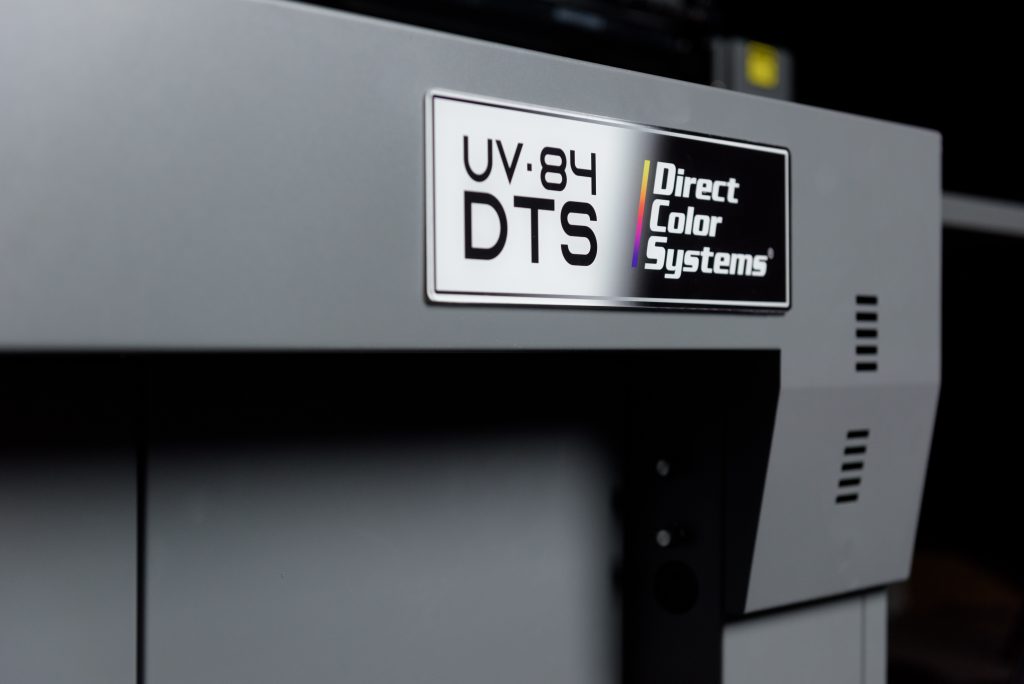
UV printing vs screen printing is not a question about which process is better. It is a question about three things a shop already knows before the job starts: how long the run is, how many colors the artwork carries, and whether the object will lie flat under a screen. Answer those three and the process picks itself.
This guide sets the two side by side for hard goods (drinkware, signage, awards, panels, name badges, industrial parts) and shows where UV-DTF transfers reach objects that neither a screen nor a flatbed bed can hold.
The short version
- Screen printing makes one stencil per color, then repeats that setup cheaply. Long runs of one flat design reward it.
- UV printing images straight from the file. No stencil means color count and artwork changes cost nothing extra at setup.
- Shape decides more than either. A screen needs a flat presentation; a UV flatbed needs the piece to sit still under the head.
- UV-DTF covers the rest: a printed transfer that goes onto handled drinkware, reflective materials and odd or oversized objects.
- Neither UV process is for garments. Direct Color Systems states plainly that its UV-DTF system is not intended for garments.
What Each Process Actually Does
Screen printing is a stencil process. Each color in the artwork gets its own mesh screen, ink is pushed through the open areas onto the surface below, and the screens are registered so the colors land on top of each other correctly. The work sits in the setup. Once the screens exist and register, running the hundredth piece costs very little more than the tenth.
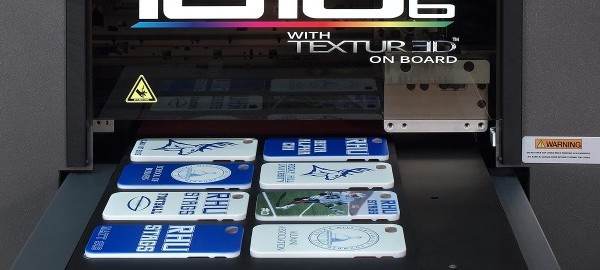
UV printing is a digital process. A UV-LED printer reads the file and jets the image directly onto the object, curing the ink with UV light as it goes. There is no stencil to make, so a six-color design and a one-color design take the same preparation, and the next piece can carry different artwork without touching the machine. Direct Color Systems builds this as direct-to-substrate inkjet printing: ink onto the finished item rather than onto a label or a decal applied afterward.
That single structural difference, stencil versus file, is where every practical trade-off below comes from.
Where UV Printing Fits
Three conditions point to UV printing, and they tend to arrive together.
Short runs. Screen setup is paid once and amortized across the run. On a run of twenty-five, there is not much to amortize it across. A UV-LED printer starts at the first piece.
Artwork that changes. Serial numbers, names, part identifiers, one-off personalization. Each change is a new set of screens on the stencil side and a new file on the digital side. This is why name badge printing and serial plate and dial face printing are digital work almost by definition.
Color count and texture. Every additional color is another screen, another registration, another setup. A UV-LED printer lays the full image in one pass, and can stack ink into a raised layer in the same pass. That is the basis of the TEXTUR3D textured printing process DCS uses for tactile and braille work.
Substrate range follows from the same place. Because the ink cures on contact rather than soaking in or air-drying, the same machine prints glass, wood, acrylic, aluminum and coated metals without changing process.
Where Screen Printing Still Fits
The honest answer is: long, repeating, flat work.
If a shop prints the same two-color logo on five thousand identical flat blanks, the screens get made once and then the per-piece cost is about ink and labor. That is a genuine advantage and no digital process argues with it. Screen printing also remains the established route for apparel, which is outside what UV-LED hard-goods printing does at all.
The decision usually turns on where a shop's actual order book sits. If most jobs are large, identical and flat, screens earn their floor space. If most jobs are small, varied or shaped, the setup that made screens efficient becomes the thing slowing the shop down. (Specific break-even quantities depend on a shop's own labor and screen costs, to confirm against your own numbers.)
UV-DTF vs Screen Printing When the Object Is Not Flat
The comparison changes shape once the object does. A screen has to meet the surface; a flatbed has to hold the piece still beneath the printhead. A mug with a handle defeats both.
UV-DTF is the answer to that case. A UV-LED printer prints the full-color graphic onto a printable film, a thermal laminator bonds an adhesive film over it, and the finished transfer is applied to the object and peeled away. Direct Color Systems describes its UV-DTF films as products that "can be applied to a variety of substrates that can be difficult to customize with conventional systems," and names "drinkware that has a handle, reflective materials and odd or oversized objects" as good candidates. The finished graphic is, in the company's words, "durable, dishwasher safe."
Against screen printing on these items, UV-DTF wins on access rather than on cost per piece: it puts a full-color image where a stencil cannot reach. Against direct printing, it complements rather than replaces. A flat tile, a sheet of glass or a rigid panel is natural direct work, and so are round items a rotary fixture can turn, which is what the bottle and cylindrical printing setup is for. Handled, irregular and oversized pieces are where the film goes.
Three figures you can check
What the UV-LED side of the comparison is made of
Curing energy, and the two consumable sizes that set the largest transfer a shop can lay down in one piece.
50-75%
less energy than the equivalent mercury arc lamp, in a peer-reviewed review of UV-LED curing
11.7 x 16.5 in
the Film A sheet DCS supplies, which the printed graphic goes down on
4
Film A versions: clear for hard substrates, clear for soft substrates, silver and gold
Film B, the adhesive transfer film paired with each kit, comes on an 11.8 inch by 164 foot roll. Because the printable sheet is a fixed size, the largest single transfer does not grow with the printer bed. That is worth holding onto when sizing a machine.
What UV-LED Curing Changes on the Floor
Two things separate UV-LED curing from the mercury-arc lamps that older UV lines used, and both show up as floor conditions rather than print quality.
It runs cool. A peer-reviewed review of the technology notes that UV-LED "is suitable for curing heat-sensitive materials because of lower heat generation" (National Library of Medicine). For a transfer workflow that matters directly: the printed film is not distorted by heat before it is applied, so registration holds.
It removes mercury. The same review reports that UV-LED "consumes 50-75% less energy than the equivalent mercury arc lamp." The U.S. Environmental Protection Agency notes that mercury-containing bulbs break easily and that "recycling prevents the release of mercury into the environment". Taking the lamp out takes the disposal procedure out with it.
Neither point is a reason on its own to change process. Both are reasons a UV-LED line is easier to put in a room that also holds people, which is not always true of the alternative.
Matching the Printer to the Work
If the comparison lands on UV, the next question is bed size and configuration, not brand. Direct Color Systems builds a range of UV-LED machines, from the compact UV-21MP through the UV-32MP and UV-44DTS to the large-format UV-84DTS Gen2, alongside the VIBRAHue and ChromaSphere lines and the 7200z. The UV-LED printer lineup lists the full set with specifications, and the UV flatbed printers page groups them by format.
Size the bed to the direct work, not to the transfers. UV-DTF sheets are a fixed 11.7 by 16.5 inches on every machine, so a larger bed buys nothing for film work. It buys capacity for flat panels, signage and multi-up fixtures, which is a real reason to go bigger, just a different one. Shops decorating promotional products usually find the mix of small flat items and shaped pieces argues for a smaller bed plus the film kits rather than the other way round.
To see how a design holds on your own product before committing to either process, request a sample print, book a web demo, or contact the Direct Color Systems team through the forms on the site.
Frequently Asked Questions
Is UV printing better than screen printing?
Neither is better in general. Screen printing sets up one stencil per color and then repeats that setup cheaply, so it suits long runs of the same flat piece. UV printing images from a file with no stencil, so it suits short runs, artwork that changes piece to piece, and objects that are not flat. Decide on run length, color count and shape.
What is the difference between UV-DTF and screen printing?
UV-DTF prints a full-color graphic onto a film, laminates it to an adhesive film, and transfers it onto a hard object. Screen printing pushes ink through a mesh stencil directly onto the surface, which needs that surface to present flat to the screen. UV-DTF therefore reaches handled drinkware, reflective materials and odd or oversized objects.
Can UV printing replace screen printing on garments?
No. The DCS UV-DTF system "is not intended for garments," and UV flatbed printing is a hard-goods process. Apparel belongs to textile processes.
Do I need a separate machine to add UV-DTF?
No. The film runs on the UV-LED printer and UV inks a shop already has. DCS describes the system plus "a low-cost thermal laminator" as all that is needed to get started.
Does UV printing handle more than one color in a single pass?
Yes. A UV-LED printer lays the full color image, and white ink where the design needs opacity, in one pass. Screen printing separates each color onto its own screen, so color count drives setup work rather than print time.